
Large language models usually receive most of the attention in discussions about voice agents. We compare reasoning capabilities, benchmark new models, debate which voice sounds the most natural, and explore increasingly sophisticated realtime APIs.
But some of the hardest problems in voice interfaces have very little to do with generating answers.
One of them is timing.
Reply too early, and the agent interrupts the user before they finish speaking.
Reply too late, and the conversation feels awkward and sluggish.
Behind this seemingly simple problem lies an often overlooked component: Voice Activity Detection (VAD).
Before a voice agent can answer intelligently, it first needs to know whether someone is speaking, whether they have stopped speaking, and whether it should continue listening or begin responding.
This article explores what VAD is, how it fits into modern voice-agent architectures, why VAD alone is often not enough, and how different approaches are evolving to make conversations feel increasingly natural.
The Timing Problem in Voice Agents
Natural conversations are remarkably sensitive to timing.
Imagine answering an interview question:
"I think my biggest weakness is..."
The agent immediately jumps in:
"Thank you for sharing your weakness."
The interruption feels unnatural.
Now consider the opposite.
You finish speaking.
The agent waits, one second, two seconds and eventually it responds.
Nothing is technically broken, yet the interaction feels slow and uncomfortable.
The challenge is that conversational timing exists within a narrow window between these two extremes. Humans navigate this effortlessly. Voice agents need systems that help them make similar decisions.
Before an agent can decide what to say, it must first decide when to speak.
What Is Voice Activity Detection?
Voice Activity Detection, commonly abbreviated as VAD, is a technique used to determine whether an audio segment contains human speech.
Importantly, VAD answers only a very simple question:
- Is there speech present in this audio stream?
It does not determine:
- What was said
- Who said it
- What the speaker intended
- Whether the statement is complete.
Its output is typically binary:
Audio(Speech, Silence, Background Noise...) -> VAD -> Speech / Non-SpeechThat simplicity is precisely why VAD is useful.
Realtime voice systems continuously receive audio from microphones. Much of that audio may contain silence, breathing, keyboard typing, environmental sounds, or background conversations.
Without VAD, downstream systems would need to process everything.
Why Voice Agents Need VAD
VAD plays several important roles inside voice agents.
It can help determine when transcription should begin. It can prevent silence from being sent continuously to speech recognition services. It can reduce bandwidth usage and cloud costs by avoiding unnecessary processing.
More importantly, VAD provides the earliest signal that a user has started speaking—or stopped.
That signal becomes one of the foundations upon which natural conversations are built.
How VAD Works (At a High Level)
Although implementations differ, most VAD systems follow a similar pattern.
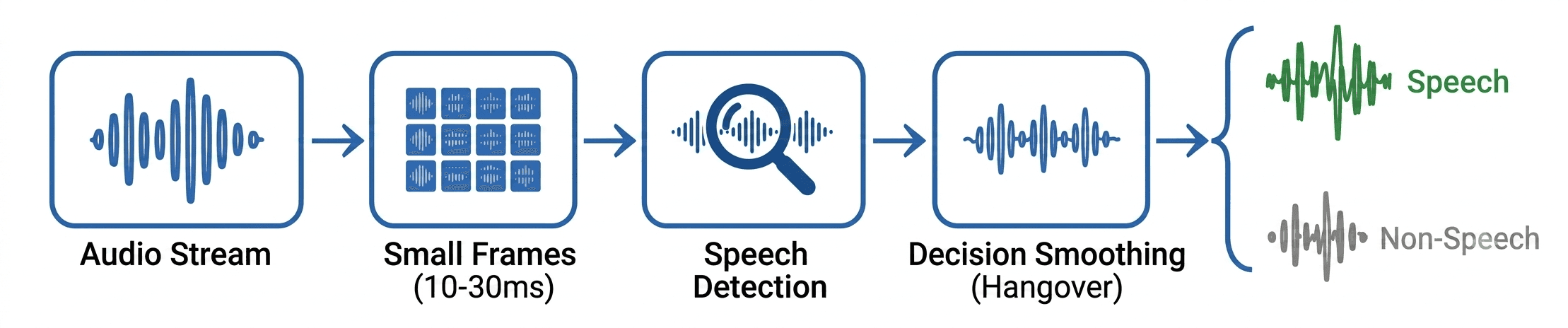
Audio arrives continuously and is divided into very small chunks, often around 10 to 30 milliseconds long.
Each chunk is analyzed to determine whether it likely contains speech.
Those decisions are then smoothed to avoid rapidly switching between speech and silence.
Conceptually, the flow looks like this:
Some implementations rely on traditional heuristics developed for realtime communication systems. Others use neural networks trained on large speech datasets.
Regardless of the underlying approach, the goal remains the same:
Provide a stable signal indicating whether someone is currently speaking.
VAD in the Voice Agent Pipeline
Although VAD itself is relatively simple, its position inside a voice-agent architecture gives it significant influence over the overall experience.
Before Speech Recognition
One common deployment pattern places VAD before speech recognition.
The flow looks roughly like this:
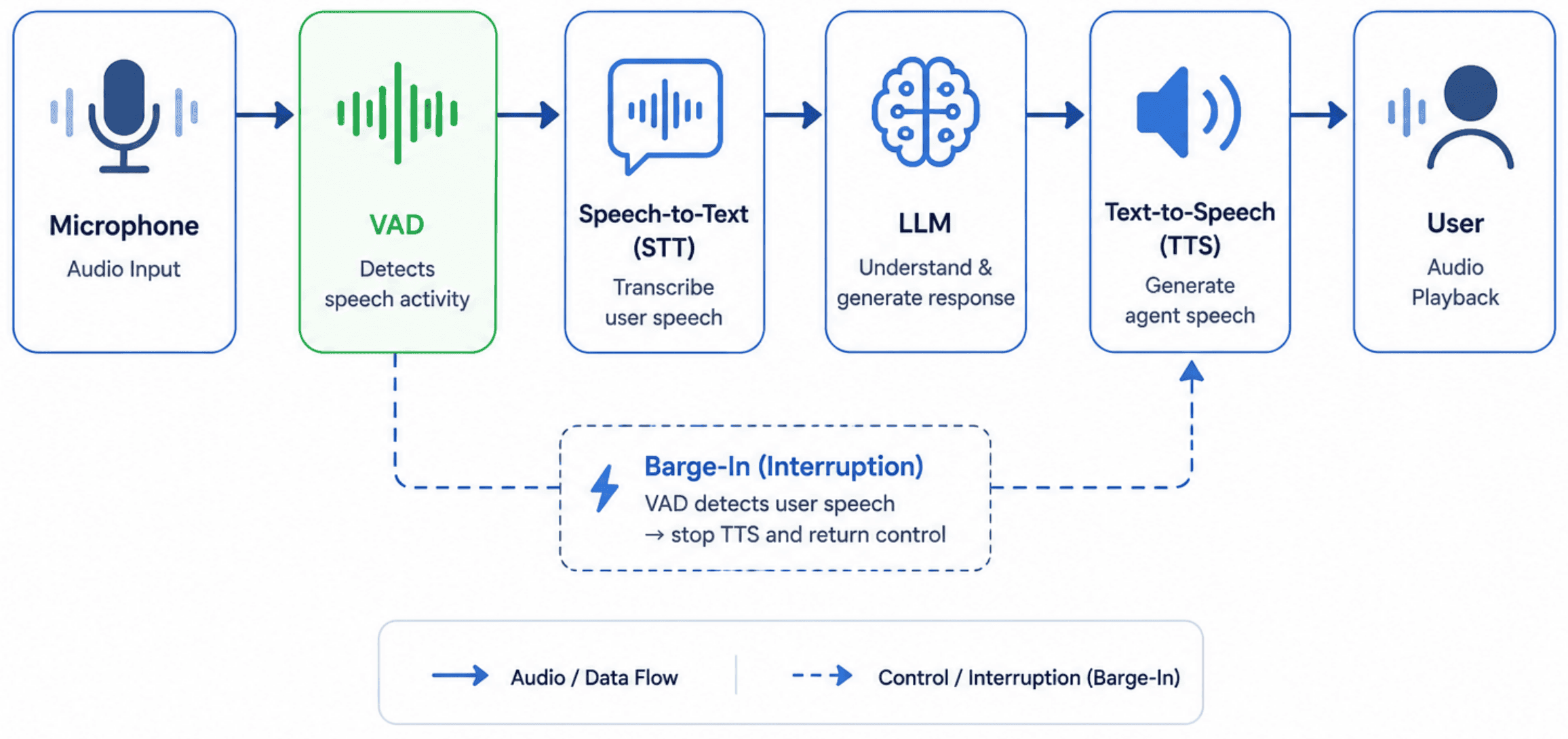
In this setup, VAD acts as a gatekeeper.
Only audio segments identified as speech are forwarded to transcription services.
This approach can improve efficiency and reduce unnecessary API calls.
During Conversation
VAD is not simply a one-time filter.
During a live conversation, it continuously monitors the incoming audio stream.
It helps answer questions such as:
- Has the user started speaking?
- Is the user still speaking?
- Has the user stopped?
- Did they resume after a short pause?
These signals influence how the broader voice pipeline behaves.
During Agent Playback
One particularly important use case involves interruptions.
Human conversations frequently overlap. People interrupt each other to clarify, ask follow-up questions, or correct themselves.
Suppose the agent is currently speaking.
If the user begins talking, VAD can detect new incoming speech and trigger the system to stop text-to-speech playback, returning control to the user.
This capability—often referred to as barge-in—is one of the key ingredients behind natural-feeling voice experiences.
Without it, users are forced to wait politely for the agent to finish every response.
Most people do not converse that way.
Silence Is Not the End of a Sentence
At first glance, VAD appears sufficient.
- Detect speech.
- Detect silence.
- Respond.
In practice, the situation is much more complicated.
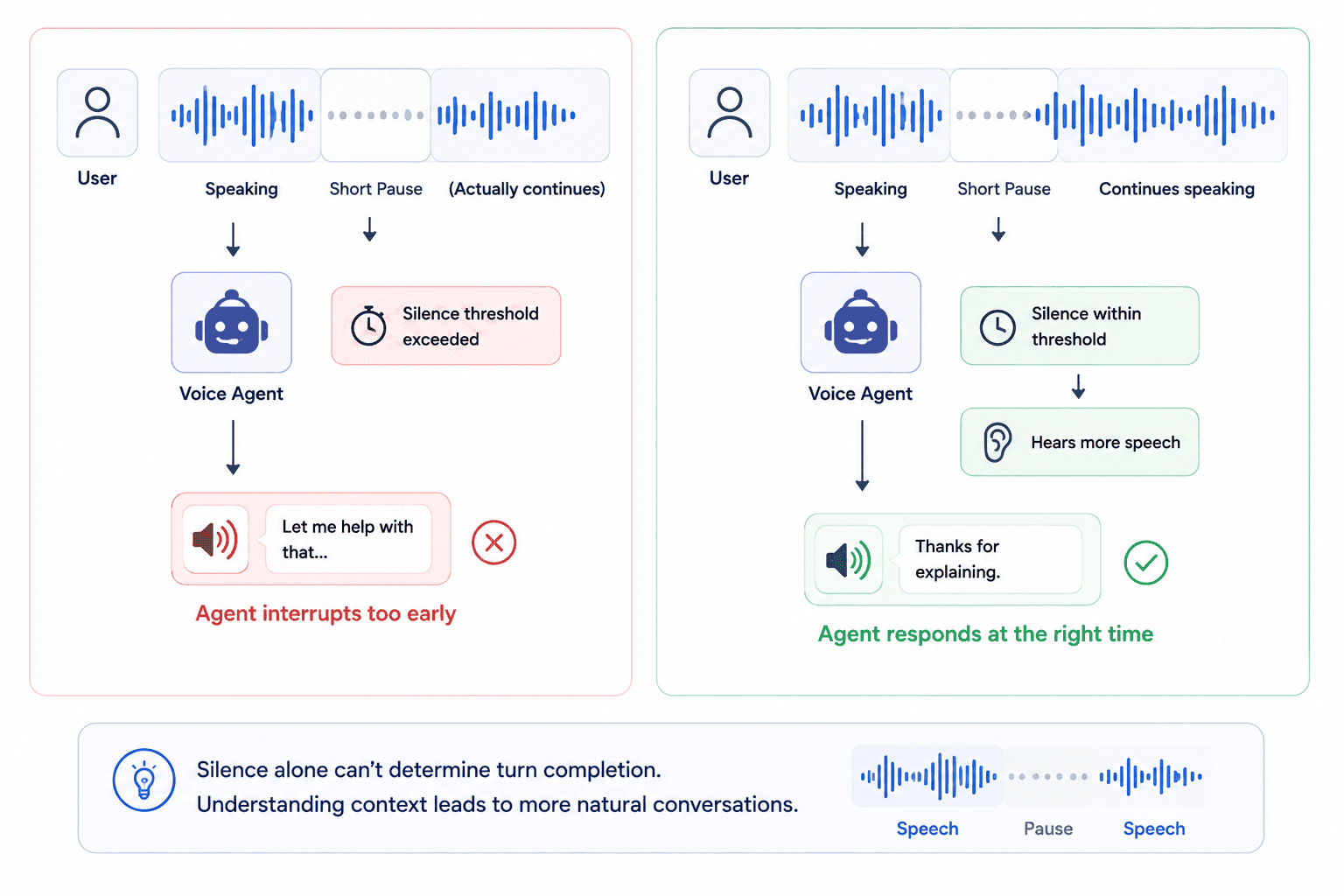
Silence does not necessarily mean the user has finished speaking.
Traditional Turn Detection
Many systems build turn detection using VAD combined with silence thresholds.
If silence persists beyond a predefined threshold—often a few hundred milliseconds—the system assumes the user's turn has ended.
This approach is simple, fast, and computationally inexpensive.
It remains widely used today.
VAD vs Endpointing
VAD and endpointing are often discussed together, but they solve different problems.
VAD determines whether speech is currently present in the audio stream.
Endpointing builds on that signal to decide whether the user's turn has likely finished and whether the system should begin responding.
In other words:
VAD answers:
"Is someone speaking right now?"
Whereas endpointing asks:
"Is this person done speaking?"
Many production voice systems combine both mechanisms.
Detecting speech is relatively straightforward.
Deciding when someone has truly finished speaking is considerably harder.
Silence Thresholds Limitation
The difficulty is that humans often pause mid-thought.
For example:
"I worked at Amazon for three years..."
(thinking)
"...before moving into product management."
The pause is meaningful.
It reflects hesitation, recall, emphasis, or reflection.
A silence-based detector cannot distinguish between:
"I'm still thinking."
and
"I'm done."
Increasing the silence threshold can reduce interruptions, but it introduces another problem: slower responses.
The system becomes more patient, but also feels less responsive.
This highlights one of the fundamental trade-offs in voice interfaces:
Responsiveness versus conversational naturalness.
There is no universal setting.
The right balance depends heavily on the product and the experience it aims to deliver.
The Rise of Semantic Turn Detection
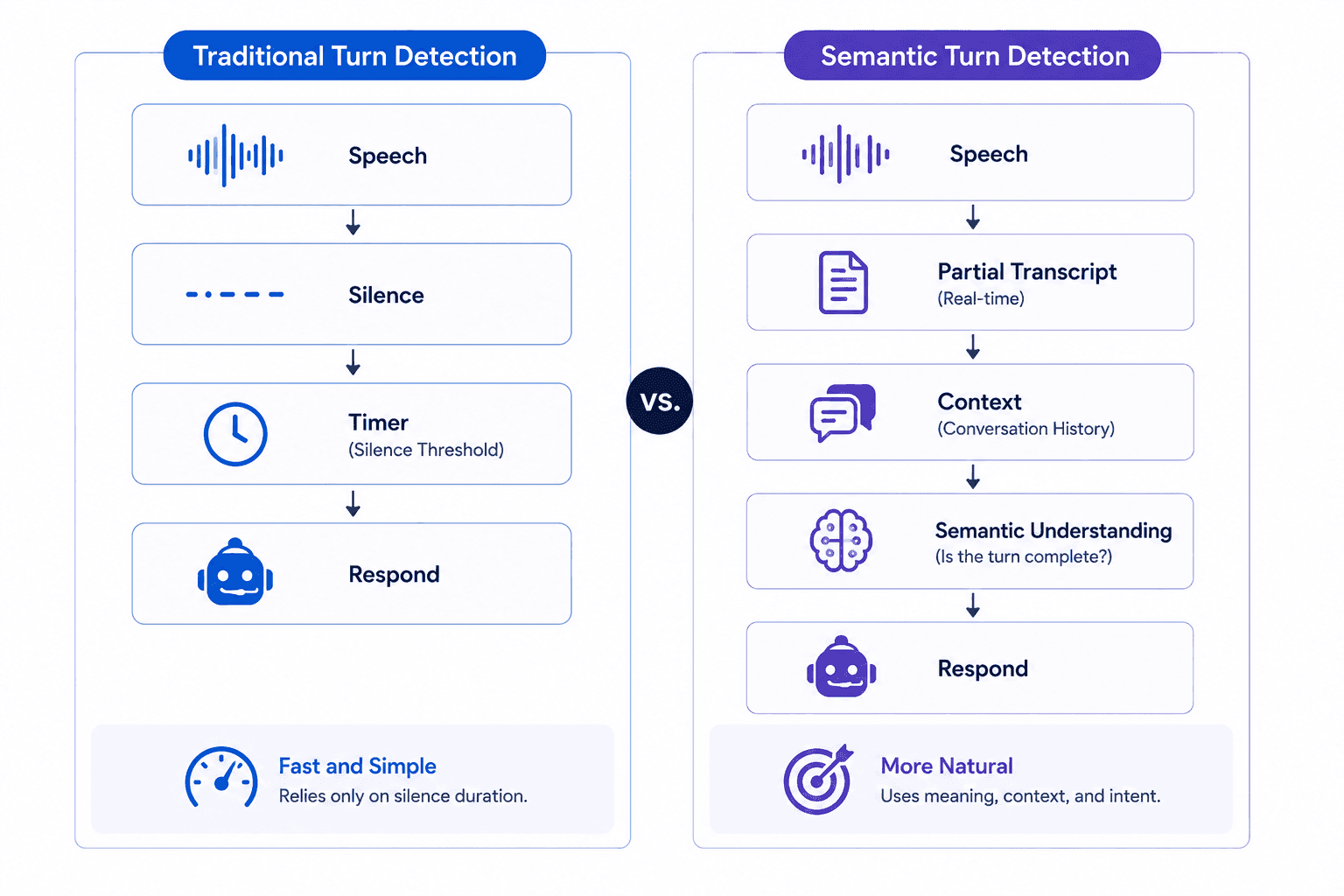
Modern voice systems increasingly combine acoustic signals with linguistic understanding.
Instead of asking:
"Has the user stopped making noise?"
they ask:
"Does this utterance appear complete?"
This idea is often referred to as semantic turn detection.
Rather than relying solely on silence duration, these approaches may incorporate:
- Partial transcripts
- Conversational context
- Language-model understanding
- Prosodic cues such as intonation and emphasis.
Consider the difference:
"I think my biggest weakness is..."
compared with:
"I think my biggest weakness is overthinking under tight deadlines."
Both sentences may end with silence.
Only one feels complete.
Semantic turn detection attempts to recognize that distinction.
This additional understanding can improve conversational naturalness, although it introduces greater complexity and computational cost.
As voice agents become more sophisticated, the decision of when to respond increasingly shifts from purely acoustic signals toward a combination of speech detection and language understanding.
Real-World Challenges
Production voice systems rarely operate in ideal conditions.
The environment surrounding the user often determines whether VAD performs well.
Background Noise
Users rarely speak from quiet recording studios.
They may be in cafés, offices, cars, airports, or homes with televisions playing in the background.
Environmental sounds such as keyboard typing, traffic, fans, and other conversations can influence detection quality.
Poor VAD decisions often cascade through the rest of the system:
- Poor detection.
- Poor transcription.
- Poor understanding.
- Poor conversations.
Echo and Feedback
Another challenge arises when the agent hears itself.
Audio generated by text-to-speech may leak back into the microphone, causing feedback loops and false detections.
To address this, many realtime communication systems incorporate techniques such as:
- Acoustic Echo Cancellation (AEC)
- Noise Suppression (NS)
- Automatic Gain Control (AGC)
These technologies often work alongside VAD to improve robustness.
Interruptions and Barge-In
As discussed earlier, interruptions are normal.
A voice agent that cannot be interrupted quickly feels rigid.
Conversely, a system that interrupts too aggressively becomes frustrating.
VAD frequently provides the first indication that a user intends to reclaim the conversational turn.
Achieving the right balance remains one of the most challenging aspects of voice-agent design.
Multiple Speakers
Voice agents are increasingly moving beyond one-on-one interactions.
Meeting assistants, collaborative agents, and household devices may encounter multiple simultaneous speakers.
Questions quickly emerge:
- Who should the agent listen to?
- Who should it respond to?
- How should it track speaker identity?
These scenarios introduce additional techniques such as speaker diarization and participant tracking.
They also highlight how VAD represents only one piece of a broader conversational system.
Exploring Open-Source VAD
Several open-source VAD implementations are commonly used in modern voice systems.
Each reflects different trade-offs.
WebRTC VAD
Originally developed for realtime communication systems, WebRTC VAD remains one of the most widely deployed implementations.
Pros
- Extremely lightweight
- Low CPU usage
- Battle-tested in RTC environments
- Fast execution
Cons
- Limited configurability
- Binary speech/non-speech output
- Less robust in noisy conditions compared with newer neural approaches.
Best Fit
- Embedded systems, resource-constrained environments, and latency-sensitive realtime applications.
Silero VAD
Silero VAD has become one of the most popular choices within the AI voice community.
It uses neural networks to improve detection quality while remaining practical to deploy locally.
Pros
- Strong accuracy
- Better robustness to noise
- Easy local deployment
- Large community adoption
Cons
- Higher computational requirements than WebRTC VAD
- Additional machine learning dependencies
Best Fit
- Most modern voice-agent projects seeking a balance between performance and simplicity.
TEN VAD
TEN VAD is a newer entrant designed with realtime applications in mind.
Although less mature than WebRTC or Silero, it reflects the industry's broader movement toward neural approaches optimized for low latency.
Pros
- Designed for realtime scenarios
- Neural approach
- Focus on low-latency operation
Cons
- Smaller ecosystem
- Fewer production examples
- Less community knowledge available
Best Fit
- Teams experimenting with emerging realtime architectures and evaluating newer components.
Choosing the Right Approach
Selecting a VAD strategy involves balancing naturalness, latency, complexity, and operational constraints.
For many prototypes and production systems, Silero VAD offers an excellent balance between accuracy and ease of use.
For embedded deployments or highly constrained environments, WebRTC VAD remains highly relevant.
When conversational timing becomes especially important, VAD alone is often insufficient.
Modern systems increasingly combine multiple signals:
VAD + Endpointing + Partial Transcripts + Semantic SignalsThe result is not a single component deciding when to speak.
Instead, it is a collection of cooperating mechanisms working together to manage the flow of conversation.
Closing
Large language models may generate the answers, but they do not determine the rhythm of a conversation.
That responsibility often begins much earlier.
The difference between a voice agent that feels smooth and one that constantly interrupts can come down to a few hundred milliseconds—and the systems responsible for deciding whether the user is still talking.
Voice Activity Detection may not be the most visible component in a voice stack, but it quietly enables many of the experiences users take for granted.
As voice interfaces continue to evolve, the future will likely involve increasingly sophisticated combinations of VAD, endpointing, semantic understanding, and realtime interaction models.
Knowing what to say matters.
Knowing when to say it may matter just as much.
References
Deepgram — Voice Activity Detection: An Overview for Production Voice Applications
Picovoice — Complete Guide to Voice Activity Detection (VAD)
Deepgram — Endpointing
Deepgram — End-of-Speech Detection While Live Streaming